This year’s PKO Gdynia Half Marathon will have a special character – it’s part of the city’s 100th anniversary celebrations. Runners can expect a unique setting and a return to the course finishing right in the middle of the beach.
Along the way, runners will pass places and buildings important to Gdynia’s history. Ten thousand participants — that’s how many the organizers are expecting — will start from Kościuszko Square. It’s an iconic spot, the very heart of the city’s tourist area. Here you can see the Dar Pomorza and ORP Błyskawica. The first one is a three-masted training ship purchased by the people of Pomerania in 1929 for the Maritime School in Gdynia. Since 1982, it has been moored in Gdynia as a museum ship.

The second one is a Polish destroyer, introduced into service in the Navy in 1937. It took part in World War II operations from the first to the last days of fighting in Europe. Since 1 May 1976 it has been moored in the Port of Gdynia as a museum ship and a representative ship of the Polish Navy, still remaining in service. It is the oldest preserved destroyer in the world./p>
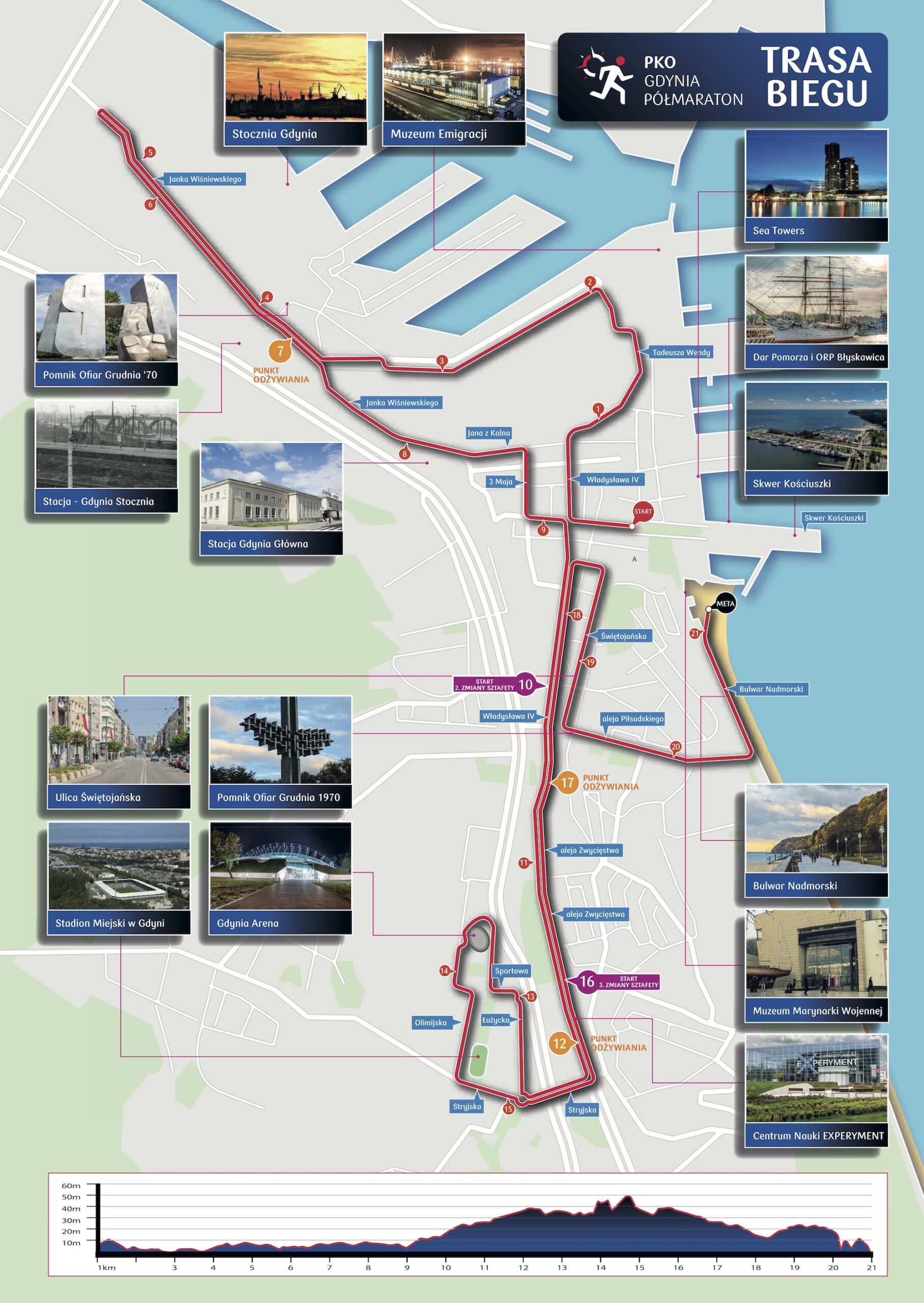
Runners won’t have time to explore the ships, though. If they want to compete for the Polish Championship medals, they’ll need to head quickly toward Władysław IV Street and then Tadeusz Wendy Street. Along the way, they’ll pass Gdynia’s tallest buildings – the Sea Towers complex, rising 142 and 125 meters high.
After 2 kilometers, the half marathoners will pass another important landmark in Gdynia – the Emigration Museum, which documents the stories of Polish emigrants.

4th kilometer – “Black Thursday”
Near the end of the 4th kilometer, runners will pass the Monument to the Victims of December 1970. The obelisk shows the date 1970, with the number 7 symbolizing a man falling forward, his back “scarred” by bullets. The monument commemorates the tragic events of December 17, 1970. On that day, known as “Black Thursday,” the militia and army opened fire on workers heading to the Gdynia Shipyard. At least 18 people were killed, and hundreds were injured, including many bystanders.

The PKO Gdynia Half Marathon route runs through a city with a hundred years of history. We want to share that story with the world. Along the way are places that witnessed tragic events, but also many buildings and institutions that shape today’s Gdynia as a dynamic and modern city.
Maciej Stroiński, spokesperson for the PKO Gdynia Half Marathon
The next 3 kilometers take runners on a fast stretch along Janka Wiśniewskiego Street, with a turnaround heading back toward the city center. At the 7th kilometer, near the Gdynia Shipyard railway station, the first refreshment point will be located.

8th kilometer – Gdynia Główna
A kilometer later, runners will pass the Gdynia Główna railway station. The beautiful modernist building was completed in 1926 and is seen by over 13 million passengers every year. Gdynia Główna is one of Poland’s busiest stations in terms of passenger traffic. The race route then continues along Jana z Kolna, 3 Maja, and once again Władysława IV streets. Around the halfway point, runners will face a gentle but fairly long uphill section, after which they’ll find the next refreshment point at the 12th kilometer.
Watch the animation of the PKO Gdynia Half Marathon 2026 route:
“Sporty” kilometers
The most “sporty” part of the route runs past the Polsat Plus Arena Gdynia, the headquarters of the Gdynia Sports Center, and the City Stadium. After winding through Sportowa, Olimpijska, and Stryjska streets, the runners will continue along Aleja Zwycięstwa. The most recognizable landmark on this stretch is the EXPERYMENT Science Center, located at the 16th kilometer.

The final five – saving the best for last
After passing the 16th kilometer, the route begins a roughly 2-kilometer downhill stretch. It’s a perfect spot to gather strength for a strong finish — especially since halfway down there’s the third and final refreshment point. The last 3 kilometers are the “crème de la crème” of the PKO Gdynia Half Marathon. First comes the iconic, vibrant Świętojańska Street, where even a short uphill section will feel easier thanks to the cheering crowds. This 1,800-meter-long and 24-meter-wide avenue was once known as Gdynia’s main “shopping salon.” Along its length stand 150 tenement buildings housing shops, cafés, and restaurants.

Right by the Gdynia City Hall, runners will turn into Piłsudski Avenue and head downhill again, all the way to the Feliks Nowowiejski Seaside Boulevard. It’s one of Gdynia’s most special places. The first promenade was built here in the 1920s. In 1949, a storm destroyed the boulevard, but it was rebuilt in the 1960s. The city’s most famous monument – the Fish – stands along the boulevard. It’s not only a must-see walking route for tourists but also a breakwater protecting the slope of Kamienna Góra.
Finish on record-breaking sand
The finish line of the PKO Gdynia Half Marathon 2026 promises pure emotion and unforgettable moments. Music, hosts, lights, and… the beach. There’s no better or more symbolic place to end the race than the City Beach. All the finish infrastructure will be set up on the sand, but runners will cover the final meters on special mats laid out on the beach. This is the very spot where, in 2020, world champions crossed the finish line, and Kenya’s Peres Jepchirchir broke the women’s half marathon world record. Among men, the winner was Jacob Kiplimo, who still holds the current world record in the half marathon. For many years, the City Beach also served as the finish line for the legendary IRONMAN triathlon events.

Cheering zones will be set up along the entire route. The organizers have already announced that, just like in 2025, next year’s PKO Gdynia Half Marathon will also feature a city game, where supporters can collect stamps for visiting designated fan spots.

Polish Championships for the city’s birthday
This year’s PKO Gdynia Half Marathon will have an extra dimension. For the first time in history, Gdynia will host the official 35th Polish Athletics Association Half Marathon Championships, with additional age group classifications. The Polish Athletics Association has decided to award medals in as many as six age categories:
- women and men aged 20–29
- women and men aged 30–39
- women and men aged 40–49
- women and men aged 50–59
- women and men aged 60–69
- women and men aged 70 and over
Anyone wishing to be classified in the championships will need to give their consent during registration to be included in the competition results.
Free registration will be a ticket to being recorded twice in the history of Polish running – on one hand, it offers the chance to win the national championship title, and on the other, to appear in the official statistics kept by the Polish Athletics Association. The process will be completely free and voluntary, and it will come with new benefits that were not available before.
We’ve been following running events in Gdynia for years, and we’re glad they will reach the rank of national championships next year. I’m convinced that the PKO Gdynia Half Marathon, now as the Polish Championships, is yet another great reason to take part in this exceptional event.
Marek Plawgo – Vice President of the Polish Athletics Association
Team Karolina vs. Team Krystian
At the start line will be Krystian Zalewski – one of the best Polish long-distance runners of recent years, multiple national champion, and silver medalist at the European Championships in the 3000-meter steeplechase. The participation of Karolina Nadolska – two-time Olympian and Polish record holder in the half marathon and 10-kilometer run – is still uncertain.

However, Karolina and Krystian have an even more important mission – they have become ambassadors of the PKO Gdynia Half Marathon – the 35th Polish Athletics Association Half Marathon Championships. They will form two teams that will compete against each other on the course. Every participant registering for the race will be able to choose which team they want to join and optionally make a donation, which will later be given to a charity selected by Karolina or Krystian. The winning team will be determined based on the average net time of all its members.
Soon, Karolina and Krystian will present their training plans, which they are already preparing for their teams. After the New Year, they will also start hosting demonstration lessons in Gdynia’s schools.